 11
11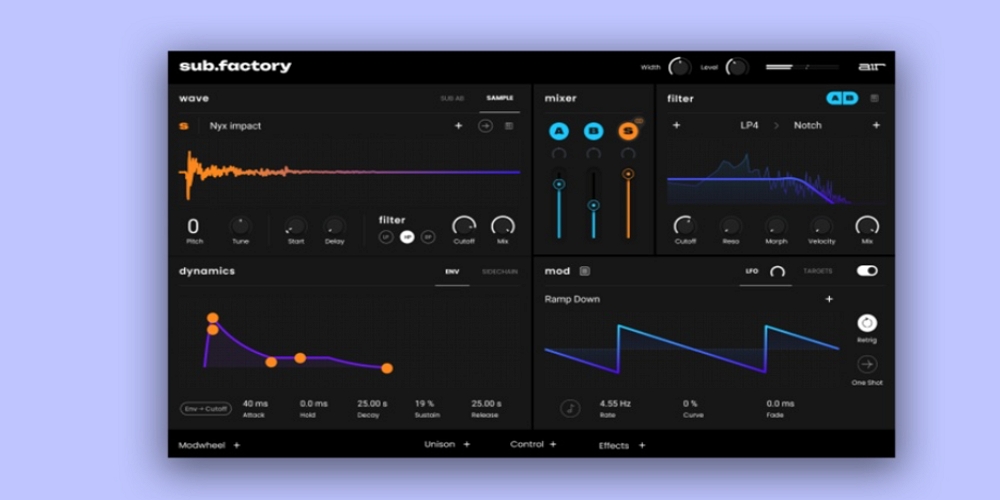
Whether you produce trap, hip-hop, EDM, or techno, the bass is the backbone of your track. The right 808 or bass synth plugin can be the difference between a mix that hits hard and one that gets lost in a sea of sounds. But with dozens of options on the market — spanning analog modeling, wavetable synthesis, hardware-sampled instruments, and dedicated 808 tools — finding the right plugin for your workflow can feel overwhelming.
This guide cuts through the noise. We tested and reviewed the best bass and 808 synth plugins available today, covering free options and premium tools, beginner-friendly instruments and deep sound design engines, so you can find the right fit at any skill level and budget.
Not sure where to start? Here’s a fast overview of every plugin in this roundup.
| Plugin | Best For | Type | Price |
| SubLab XL | Best Overall 808 | Dedicated 808 Instrument | $25–$80 |
| 808 Studio 2 | Best for Beginners | 808 Synthesizer | $30–$69 |
| AIR Sub Factory | Best Hybrid Engine | Wavetable + Sampler | $29–$99 |
| Moog Mariana | Best Analog Synth Bass | Analog-Modeled Synth | $39–$99 |
| Vital | Best Free Option | Wavetable Synthesizer | Free |
| Softube Monoment Bass | Best Mix-Ready Bass | Hardware-Sampled Synth | $35–$99 |
| SubBoomBass 2 | Best for Sound Design | Multi-Engine Bass Synth | $75–$99 |
| Bass Master | Best Sample-Based | Sample Instrument | $29–$99 |
| OVRDRV 808 Techno | Best 808 Sample Pack | Sample Pack (WAV) | $19.99 |
A bass or 808 synth plugin is a software instrument designed to generate and shape low-frequency sounds in a digital audio workstation (DAW). The term “808” refers to the Roland TR-808 drum machine, released in 1980, whose bass drum — or “kick” — produced an unusually deep, booming low-end that could be tuned and sustained like a note. Producers in hip-hop and electronic music later discovered they could manipulate these bass drum sounds into fully melodic basslines, and the 808 became the defining sound of modern trap, hip-hop, R&B, and EDM.
Today, bass and 808 plugins come in three main categories:
Best for: Trap, hip-hop, drill, R&B, Afrobeats
| Type | Dedicated 808 / sub-bass instrument |
| Developer | Future Audio Workshop |
| Price | $80 (regular) | $25–$50 on sale — nearly always discounted |
| Formats | VST2, VST3, AU, AAX (64-bit) |
| Compatibility | macOS 10.12+ (Apple Silicon native) | Windows 8+ |
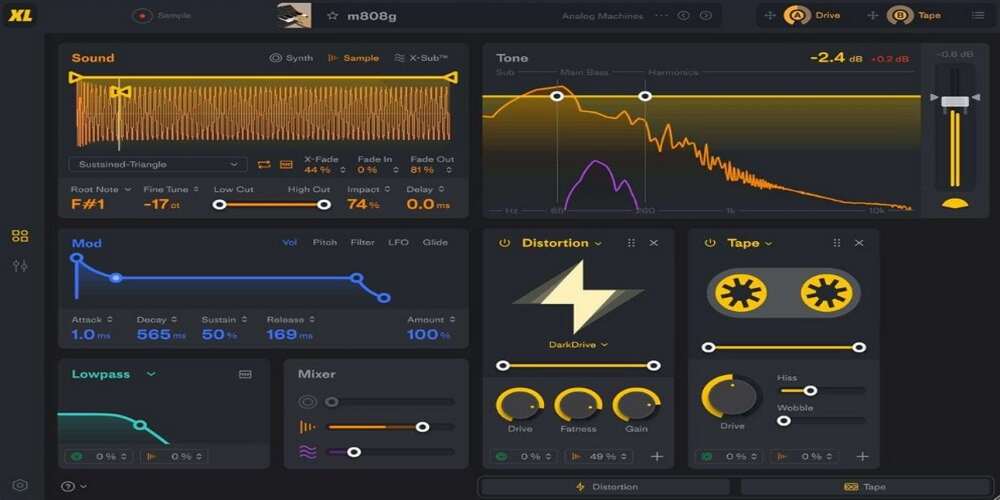
SubLab XL is the consensus pick among working producers for a reason. It was built from the ground up to do one thing better than anything else: make 808s that hit hard, translate across every playback system, and sound mix-ready without extra processing.
At the core of SubLab XL is a three-layer engine. The Synth Layer gives you a four-waveform oscillator — sine, triangle, sawtooth, square, and a supersaw exclusive to the XL version — with full pitch and filter modulation. The Sample Layer houses over 300 curated one-shot samples sourced from real hardware including the Roland TR-808, Korg Volca Kick, and Dave Smith Tempest. You can drag and drop your own samples too, and the plugin detects the pitch automatically.
The third layer is what separates SubLab XL from everything else on this list. The proprietary X-Sub engine generates sub-bass frequencies specifically in the 30–65 Hz range using psychoacoustic principles that ensure your low-end is perceived consistently, whether listeners are on a club system, studio monitors, or a phone speaker. No other plugin in this roundup offers anything like it.
The effects section is deep but focused: six distortion types, waveshaper, bitcrusher, tape saturation with hiss and wobble, a compressor with sidechain input, and a two-band EQ. Up to four effects can run simultaneously in any order. A macro page lets you map up to ten parameters to two macro knobs — great for live performance or quick A/B comparisons.
The preset library is another major strength. Over 100 XL-exclusive presets ship with the plugin, plus nine signature bass packs from producers like Richie Souf and DECAP, with additional expansion packs available. If you’ve heard a memorable 808 on a modern trap record, there’s a good chance SubLab XL was involved.
| ✓ Pros | ✗ Cons |
| • X-Sub engine solves sub-bass translation across all playback systems | • Higher latency (220 PDC samples) than some competitors |
| • Fastest dedicated 808 workflow on the market | • Not suited for general synthesis or lead sounds |
| • 300+ hardware-sourced samples with auto pitch detection | • Some CPU overhead on complex patches |
| • Macro controls great for performance and quick sound shaping | • Limited to bass — not a multi-purpose instrument |
| • NKS ready for Maschine and Komplete Kontrol | |
| • Strong expansion pack ecosystem |
Best for: Trap, hip-hop, drill — producers who want results fast
| Type | 808-focused synthesizer |
| Developer | Initial Audio |
| Price | $69 (regular) | $30–$40 on sale | Free demo available |
| Formats | VST2, VST3, AU, AAX |
| Compatibility | macOS 10.15+ (Apple Silicon native) | Windows 10+ |
If you’re newer to production or you just want an 808 plugin that requires zero learning curve, 808 Studio 2 is your answer. Every control is relevant, every feature serves the bass, and the workflow is so intuitive you’ll have a working 808 bassline within minutes of opening it for the first time.
The engine combines three types of sound sources: a sample oscillator with drag-and-drop support, a dedicated sub-oscillator with a “Fat Mode” and overdrive for extra weight, and two additional oscillators running oversampled waveforms for harmonic richness. It’s a straightforward setup, but it covers every 808 sound you’d want.
The feature that really sets 808 Studio 2 apart from the competition is the built-in sequencer with overlapping note support. This is what gives you that classic trap-style pitch glide — where one 808 note bends into the next — directly within the plugin, without needing to manually program it in your DAW’s piano roll. Finneas, the producer behind Billie Eilish’s catalog, has been noted as a user, which speaks to its professional applicability even for beginners.
808 Studio 2 also wins on CPU and latency. It runs significantly lighter than SubLab XL, which matters when you have multiple instances running across a session. The effect rack includes overdrive, compressor, three-band EQ, a chorus (applied to upper harmonics only, keeping the sub clean), and highpass/lowpass filters — all reorderable. A free, fully functional demo is available with only occasional noise bursts.
| ✓ Pros | ✗ Cons |
| • Lowest CPU usage and latency of any dedicated 808 plugin | • Fewer presets than SubLab XL (80 vs. 100+) |
| • Built-in sequencer with pitch glide — a genuine standout feature | • No psychoacoustic sub engine like X-Sub |
| • Sidechain from the sample layer for clean kick and bass separation | • Interface functional but less polished than Moog Mariana |
| • Free demo available — fully featured | • Expansion packs sold separately |
| • Beginner-friendly: hard to make a bad sound |
Best for: Trap, hip-hop, R&B, DnB, dubstep — also compatible with MPC hardware
| Type | Wavetable + sample-based bass synthesizer |
| Developer | AIR Music Technology |
| Price | $99.99 (regular) | $29–$49 on frequent sale | 10-day free trial |
| Formats | VST2, VST3, AU, AAX |
| Compatibility | Mac (Intel & Apple Silicon) | Windows |
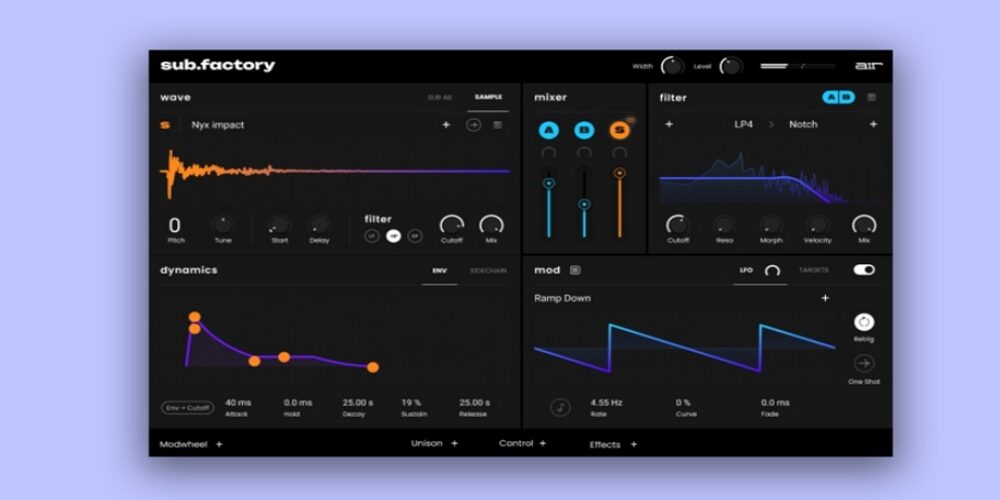
AIR Sub Factory was launched on August 8, 2024 — 808 Day — which tells you everything about what AIR Music Technology built it for. It’s a purpose-designed bass and sub synthesizer that gives you two complete synthesis approaches inside one plugin.
The engine is built around three layers. Two wavetable engines each carry hundreds of waves across analog, digital, and hybrid timbres — and each wave has 127 index points you can scan through for precise harmonic shaping. The third layer is a sample engine loaded with kicks, 808 loops, one-shots, noise, and effects samples, with start point, reverse, pitch, and filter controls.
That combination of wavetable morphing and sample layering means you can build basses that are simultaneously rooted in real hardware sounds and pushed into digital territory that pure samplers can’t reach. The modulation matrix, ring modulator, chorus, drive, and EQ effects flesh out the sound design toolkit, while unison, spread, and width controls help fill out the low-mid and stereo field.
The standout feature that no competitor can match is MPC hardware compatibility. Sub Factory runs as a standalone plugin on the MPC One, One+, Live, Live II, X, Key 61, and Key 37, making it the only bass synth in this roundup you can use without a computer. For producers working in a hardware-first setup, that alone makes it worth considering.
| ✓ Pros | ✗ Cons |
| • Combines wavetable and sample engines for the widest bass palette | • Conflicting compatibility reports on very latest macOS — verify before purchase |
| • MPC hardware compatibility is unique — no other plugin on this list offers it | • No standalone desktop application |
| • 127 wavetable index points per wave for precise harmonic control | • Smaller community and preset ecosystem than SubLab XL or Serum |
| • Broadcast-ready preset library | • Primarily optimized for hip-hop and electronic genres |
| • Frequent discounts make it excellent value |
Best for: Electronic, cinematic, synth-pop, hip-hop, experimental — any genre demanding premium analog character
| Type | Analog-modeled dual-layer bass synthesizer |
| Developer | Moog Music |
| Price | $99 desktop / $29.99 iOS | Regularly $39–$59 on sale |
| Formats | VST3, AU, AAX, Standalone (desktop) | AUv3 (iPad) |
| Compatibility | macOS 11.7+ (Apple Silicon native) | Windows 10+ | iPadOS 14.4+ |
Moog has been building some of the most iconic bass tones in music history since 1953. Mariana is the company’s software answer to the question of what a Moog bass synth could be if it wasn’t constrained by hardware limitations. The result is genuinely impressive — and genuinely demanding on your CPU.
Mariana’s architecture is built around two fully independent synth layers, each with two main oscillators (sine, triangle, sharktooth, sawtooth, square), a dedicated sub-oscillator, and a noise oscillator offering red, pink, white, blue, and purple noise. The layers can run in monophonic or duophonic mode, allowing them to play separate notes simultaneously — useful for layering complementary tones or designing bass sounds with distinct sub and upper character.
The filter section earns particular praise. Each layer gets two resonant Moog filters, plus a dedicated multimode sub-oscillator filter. These aren’t traditional Moog Ladder filters — they’re designed to handle aggressive resonance without reducing low-end, which is exactly what bass synthesis demands.
The modulation system is the deepest on this list. Per layer: three LFOs with DAW sync and phase control, three envelopes (two ADSR plus a five-stage envelope), and two random generators for organic movement. Nearly every parameter accepts modulation. The Virtual CV system adds a modular routing layer between Mariana instances and Moog’s Moogerfooger plugins, opening up patching possibilities that rival a hardware modular system.
The main caveat is CPU usage. Users consistently report 20–50% CPU per instance depending on patch complexity. On a modern Apple Silicon Mac it’s manageable, but Intel Mac and Windows users should test it carefully before committing. The plugin also has a standalone version and iOS app, making it unusually versatile across platforms.
| ✓ Pros | ✗ Cons |
| • Unmistakable Moog analog character and filter quality | • High CPU usage — the most demanding plugin in this roundup |
| • Dual-layer architecture for complex layered bass sounds | • No macro controls or single-knob shortcuts for quick sound shaping |
| • Deepest modulation system in this roundup | • No built-in sequencer or arpeggiator |
| • Virtual CV patching creates modular-style routing possibilities | • VST3 only — no VST2 for older DAW versions |
| • 200+ professional presets from notable artists | • Steep learning curve to unlock full potential |
| • Standalone app + iOS support |
Best for: All genres | Any producer on a budget | Sound designers wanting maximum control
| Type | Wavetable synthesizer |
| Developer | Matt Tytel |
| Price | Free (full synthesis engine) | $25 Plus | $80 Pro |
| Formats | VST, VST3, AU, AAX |
| Compatibility | macOS 10.12+ (Apple Silicon) | Windows 10+ | Linux (Ubuntu 18.04+) |
Vital is what happens when a skilled engineer decides to build a premium wavetable synthesizer and give the core of it away for free. The free tier includes the complete synthesis engine with no feature restrictions — only the size of the included preset and wavetable library changes across pricing tiers.
Three wavetable oscillators (one more than Serum), each capable of 32 unison voices with per-oscillator detuning, give Vital enormous low-end layering potential. Spectral warping modes let you manipulate wave shapes in ways that purely analog-modeled synths cannot, which makes it especially capable of the kind of distorted, evolving 808s that define modern trap and dubstep.
The dual independent filter modules (with over 32 filter types) allow precise shaping of sub and mid frequencies separately — a workflow advantage for bass design that requires clean lows and textured highs simultaneously. The drag-and-drop modulation system, which provides real-time 60 FPS visual feedback on every modulation connection, makes it one of the best plugins for learning synthesis from scratch.
The community ecosystem around Vital is enormous. Thousands of free 808 and bass presets are available across platforms like PresetShare, Gumroad, and Reddit’s r/VSTi — meaning even producers who don’t want to program from scratch have a vast library to work with.
| ✓ Pros | ✗ Cons |
| • Completely free with full synthesis engine — no feature locks | • No built-in sample import (unlike SubLab XL or Sub Factory) |
| • Three wavetable oscillators rivals paid synths costing $200+ | • Not 808-specific — requires synthesis knowledge to get there |
| • Visual modulation feedback makes synthesis approachable for all levels | • Factory preset library smaller than Serum’s |
| • Massive free community preset ecosystem | • Only available direct — not on Plugin Boutique or retailer sites |
| • Light on CPU despite its power | |
| • Linux support included |
Best for: House, techno, electro, pop, club music — producers who want great-sounding bass without sound design
| Type | Hardware-sampled monophonic bass synth |
| Developer | Softube |
| Price | $99 (regular) | $35–$50 on frequent sale |
| Formats | VST, VST3, AU, AAX |
| Compatibility | macOS Sonoma 14 / Sequoia 15 (Apple Silicon) | Windows 10/11 |
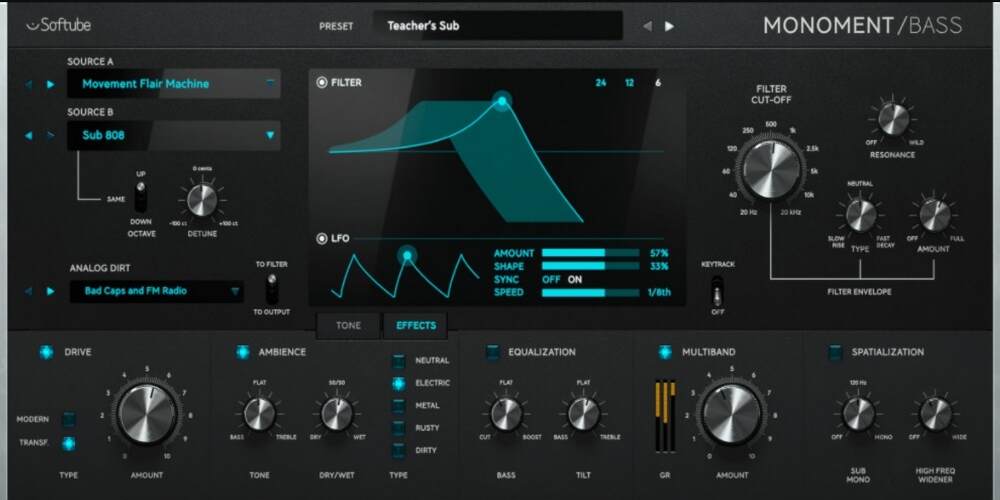
Softube Monoment Bass is the plugin for producers who want professional bass sounds without spending time on synthesis. Every sound source was recorded in stereo from rare boutique hardware synths — confirmed sources include the Nonlinear Labs C15 and the Synclavier FM — at three samples per key across the full range. The result is a 100-strong source library with the kind of natural movement and depth that software-synthesized waveforms rarely achieve.
The two-layer architecture allows you to blend two source waveforms together, either by mix level or — uniquely — by frequency crossover, so one source handles the sub frequencies and the other provides the upper character. This is a smarter approach to layering bass than most competitors offer, and it’s why Monoment Bass sounds so effortlessly full in a mix.
A third “Analog Dirt” layer adds noise and attack transients for organic texture, and the Aging control introduces subtle pitch drift and analog instability — small details that make a real difference in how “alive” a bassline feels.
The built-in effects are purpose-designed for bass: an analog-style Drive module, an Ambience reverb, a two-band tilt EQ, a Spatializer for stereo width, and a one-knob multiband compressor that the development team describes as comparable in character to an OTT-style processor. It’s one of the most useful built-in compressors in any instrument plugin.
The main limitations are its intentionally simplified envelope (no full ADSR — just Punch and Release), no pitch modulation, and an LFO that can’t be synced or retriggered. If you want deep programming control, look to Moog Mariana or Vital. If you want great-sounding bass fast, Monoment Bass is hard to beat.
| ✓ Pros | ✗ Cons |
| • Hardware-sampled sources with natural movement competitors can’t synthesize | • No pitch modulation — a significant omission for some bass styles |
| • Frequency crossover mixer is a genuinely smart layering approach | • LFO cannot sync or retrigger to note input |
| • One-knob multiband compressor rivals dedicated processing plugins | • Simplified Punch/Release envelope only — no full ADSR |
| • Extremely fast to a mix-ready result | • Requires iLok account (dongle not required) |
| • Also available as a Softube Modular and Amp Room module | • No sequencer or arpeggiator |
Best for: Intermediate and advanced producers — electronic, film scoring, game audio, experimental
| Type | Multi-engine bass synthesizer |
| Developer | Rob Papen |
| Price | $99 (regular) | $75 on sale | Included in eXplorer 10 bundle |
| Formats | VST, VST3, AU, AAX |
| Compatibility | macOS (Apple Silicon) | Windows |
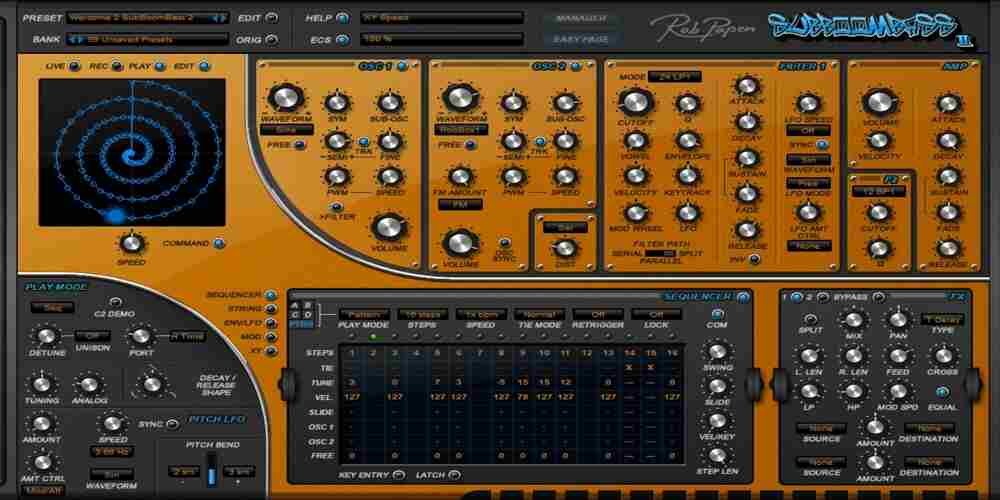
Most bass plugins in this roundup are optimized for a specific style — 808s for trap, analog warmth for electronic music. SubBoomBass 2 refuses to be categorized. It’s built around the principle that every kind of bass sound should be accessible from a single instrument, and it largely delivers on that ambition.
The oscillator section combines 128 analog-modeled waveforms, tuned percussive samples, and spectrum waveforms for a versatile starting point. The defining feature is Karplus-Strong string synthesis — a physical modeling technique that simulates plucked string vibrations and produces organic, resonant bass textures that no other plugin in this roundup can achieve. It’s the reason SubBoomBass 2 handles acid bass, plucked bass, and cello-like low-end with equal conviction.
The X/Y performance screen maps two parameters to a two-dimensional pad for real-time modulation during playback. The four-sequence pattern mode runs multiple sequences simultaneously for rhythmically complex bass patterns. A wave-sequence feature cycles through waveforms automatically, enabling evolving bass textures without manual automation.
Rob Papen updated SubBoomBass 2 in December 2025, adding all Albino 3 filter types — over 20 in total — and 100+ new presets for free. That kind of active development is rare for a plugin at this price point and gives buyers confidence in its long-term viability.
| ✓ Pros | ✗ Cons |
| • Karplus-Strong synthesis produces organic string/pluck bass unique in this category | • UI is visually denser than competitors — steeper learning curve |
| • Four-sequence pattern mode enables complex rhythmic basslines | • Sequencer described as less intuitive than 808 Studio 2’s |
| • X/Y performance pad for expressive real-time modulation | • Smaller online community and preset ecosystem |
| • Active development — free major updates | • Less focused than dedicated 808 tools for pure trap production |
| • Wave-sequence creates evolving textures without automation | |
| • Covers every bass synthesis style in one plugin |
Best for: All electronic genres | Producers who prefer presets over programming
| Type | Sample-based bass instrument |
| Developer | Loopmasters |
| Price | $89–$99 (regular) | $29 on frequent sale | 14-day free trial |
| Formats | VST 2.4, AU (64-bit) — Note: No AAX support |
| Compatibility | Windows 7–10 | macOS 10.12–10.15 (Apple Silicon support unconfirmed) |
Bass Master takes a completely different approach to the other tools on this list. Instead of a synthesis engine, it gives you 217 curated multi-sample “waveforms” — recordings sourced from legendary hardware synths and drum machines — organized across two layers (a Sub Layer for the foundation and a Top Layer for character and texture). The result is nearly 50,000 possible two-layer combinations.
The preset library is the headline feature: over 350 mix-ready presets spanning every electronic genre, from vintage funk bass to modern trap 808s, with parameters pre-mapped to a three-slot mod wheel matrix. Load a preset, make a few adjustments, and you’re done.
The Direct Out mode is a mixing engineer’s dream — it lets the sub-bass signal bypass the effects chain entirely, hitting your mix bus clean and direct while upper harmonics run through the filter and effects processing. That separation is exactly what professional mixers do manually across two plugin instances, and Bass Master does it in one click.
Thirteen filter types, a three-slot effects section, a built-in multiband output booster, and waveform randomization for one-click variation round out the feature set. If you’re willing to trade synthesis depth for workflow speed and Loopmasters’ industry-leading sample quality, Bass Master is an excellent choice.
| ✓ Pros | ✗ Cons |
| • 350+ mix-ready presets is the most preset-forward option in this roundup | • No AAX support — Pro Tools users cannot use it |
| • Direct Out mode for clean sub bypass is a professional workflow advantage | • No synthesis engine — limited to provided samples |
| • Near-50,000 possible layer combinations from 217 hardware-sourced waveforms | • Apple Silicon native support unconfirmed |
| • Waveform randomization for fast inspiration | • No sample import capability |
| • Light CPU impact | • Less sound design depth than synthesis-based competitors |
| • 14-day free trial available |
Best for: Techno, tech house, minimal techno, dark/industrial techno
| Type | Sample pack (WAV one-shots + construction kits) — NOT a plugin instrument |
| Developer | Datacode Records |
| Price | $19.99 |
| Contents | 411 samples: 180 long hits, 180 short hits, 7 drum construction kits (51 stem loops) |
| Format | 24-bit WAV, 44.1 kHz, 128 BPM | All loops DAW-ready | Key-labeled |
This is the only non-plugin entry in the roundup, and it earns its place because it solves a problem that synthesizers don’t always solve cleanly: giving techno and tech house producers immediately usable, genre-specific 808 textures without any sound design work.
Datacode started with an original Roland TR-808 and then ran every sound through an array of distortion pedals, bass amplifiers, guitar amps, filters, LFOs, delay, and reverb units. The results are sounds that occupy a specific sonic territory — overdriven, mangled, raw, industrial — that software synthesis rarely reaches without hours of work. Deep kicks, ultra-low sub drones, overdriven synth bass, filtered drone FX, and distorted bass lines are all represented.
The 180 long hits give you the melodic, sustained bass versions for writing basslines. The 180 short hits give you kick-style punches for rhythm-forward applications. Seven drum construction kits with 51 stem loops provide ready-made starting points for full arrangements. Every sample is key-labeled and tuned, so you can drop them directly into a sampler instrument and play them chromatically.
Because the samples are standard 24-bit WAV files, they work in any DAW, any sampler, any platform — no installation, no authorization, no plugin format concerns. At $19.99, the value is undeniable for producers who want authentic, processed 808 character without the time investment of building it from scratch.
| ✓ Pros | ✗ Cons |
| • Unique pre-processed 808 character impossible to replicate quickly with synthesis | • Static samples — cannot be modulated or programmed like a synthesizer |
| • Works in any DAW or sampler — universal compatibility | • Niche focus on techno/tech house limits versatility |
| • Key-labeled samples for chromatic playback | • Loops locked at 128 BPM |
| • Both long (melodic bass) and short (kick) versions included | • No MIDI files or plugin presets included |
| • Construction kits provide arrangement starting points | • Dated release (2018–2019, no updates since) |
| • Royalty-free |
The right bass plugin depends less on which is “best” overall and more on how you actually work. Here are the most important factors to consider.
Start with a dedicated 808 instrument rather than a general bass synth. SubLab XL is the professional standard — the X-Sub engine and sample library are built specifically for the punch and sub-frequency weight that trap demands. If you’re a beginner, 808 Studio 2 is simpler to learn and still produces professional results, with the bonus of a built-in sequencer for pitch glide patterns.
Moog Mariana is the clear choice for producers who want that unmistakable analog warmth and complexity. Its dual-layer engine, deep modulation, and Moog filter quality make it the most expressive bass synthesizer in this roundup. Be prepared for significant CPU usage and a steeper learning curve.
Both Softube Monoment Bass and Loopmasters Bass Master are optimized for fast results. Monoment Bass wins on sound quality and its hardware-sampled sources. Bass Master wins on sheer preset variety. Both are better choices than trying to program a general-purpose synthesizer from scratch when you just need a great bass sound by the end of the session.
Vital is genuinely one of the most impressive free pieces of music software available. Its full synthesis engine is free with no time limits and no feature locks. The only investment is time — you’ll need to learn wavetable synthesis to get the most out of it. OVRDRV: 808 Techno is also excellent value at $19.99 if your sound palette skews toward processed, industrial 808 textures.
Rob Papen SubBoomBass 2 is the most genre-agnostic bass synthesizer in this roundup. Its combination of analog modeling, Karplus-Strong string synthesis, and FM capabilities means you can make credible 808s for trap, acid bass for techno, cinematic sub-bass for film, and plucked bass for soul or funk. If you want one tool that works across all your projects, SubBoomBass 2 is worth the investment.
The 808 refers to the bass drum of the Roland TR-808 drum machine, released in 1980. Its unusually deep, booming sound — which could be tuned to different pitches and sustained like a note — was later adopted by hip-hop and electronic producers as a melodic bass instrument. Today, 808 bass is the defining low-frequency sound of trap, hip-hop, drill, and many forms of electronic music.
Both, depending on how it’s used. In its original form, the 808 was a kick drum. Modern producers use it as a melodic bass instrument — programming pitches and glides to function as a full bassline rather than just a rhythmic hit. In many trap records, the same 808 serves both functions simultaneously: it provides the kick’s low-end punch and the track’s harmonic bass movement.
Yes. Both Serum and Vital are capable of producing 808 sounds and have large communities that share 808 presets. The trade-off compared to dedicated tools like SubLab XL is workflow efficiency — you’ll spend more time programming in a general-purpose synth than you would with a plugin built specifically for 808 design. For producers who also use these synths for leads, pads, and other sounds, they’re excellent dual-purpose choices.
SubLab XL is a separate, expanded plugin — not an upgrade to the original SubLab. XL adds a supersaw oscillator, six distortion types (vs. four), waveshaper, bitcrusher, tape saturation, EQ, LFO modulation with 18 destinations, and assignable macro controls. It also comes with more presets (100+ vs. 69) and more samples (300+ vs. 250+). SubLab presets import into XL. If you’re starting fresh, SubLab XL is the clear choice.
Sub-bass frequencies below 60 Hz don’t reproduce on many consumer speakers, earbuds, or laptop speakers. When an 808 is tuned to those frequencies, listeners on small playback systems hear little or nothing. Dedicated 808 instruments like SubLab XL address this with psychoacoustic sub-bass technology — their X-Sub engine generates harmonic content that your brain perceives as deep bass even on small speakers, ensuring the 808 translates consistently across all playback systems.
Vital is the best free synthesizer for 808 design, with a full-featured wavetable engine and a large community of free 808 presets. If you want something more dedicated to 808s specifically, Initial Audio 808 Studio 2 offers a free demo that functions fully except for occasional noise bursts — enough to evaluate whether it fits your workflow before buying.
There’s no single “best” bass and 808 synth plugin — the right choice depends entirely on your workflow, your genre, and how much time you want to invest in sound design.
For most hip-hop and trap producers, SubLab XL is the safest investment: it’s the industry standard for a reason. Beginners should start with 808 Studio 2 for its lower cost and simpler interface. Producers who want analog depth should look at Moog Mariana. Those building on a budget have no better option than Vital.
The most important thing is to pick one tool and learn it thoroughly. Deep familiarity with a single bass plugin will always produce better results than shallow knowledge of ten.
Other Related Guides: