 11
11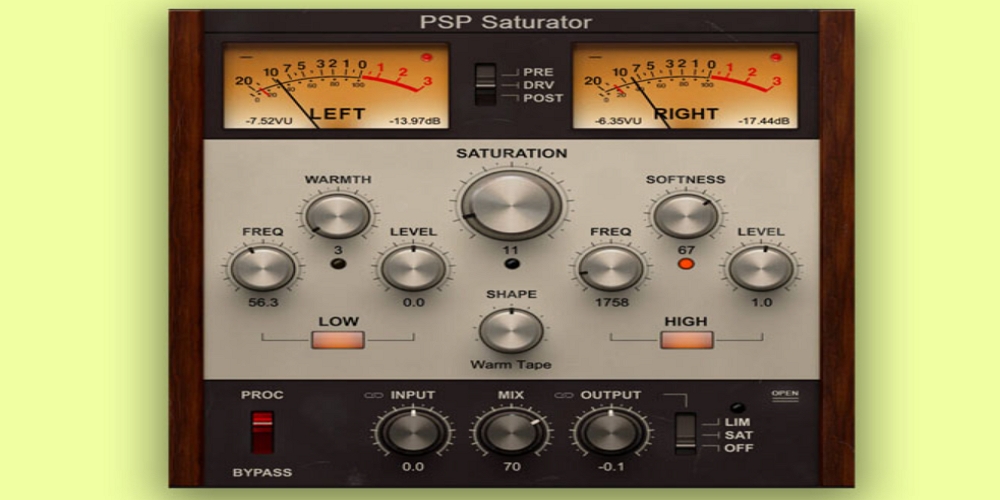
If you have spent any time on mixing forums like Gearspace or KVR, you have likely seen PSP Audioware described as the most underrated plugin developer in the business. The Polish company has been crafting professional-grade audio tools since 2000, and its PSP VintageWarmer remains one of the most recognized saturation plugins ever made.
PSP Saturator, released in late 2021 and priced at $99, represents everything the company has learned about analog emulation over more than two decades. It is not the flashiest saturation plugin on the market, and it certainly does not scream for attention with a trendy interface. But after spending serious time with it across multiple mixes, the verdict is clear: this is one of the most musically satisfying saturation tools you can buy at any price.
Still interested, dig deeper into our PSP Saturator Review:
At its core, PSP Saturator emulates the harmonic behavior of analog tape machines and valve circuits. But unlike many saturation plugins that apply a single distortion algorithm across the entire frequency spectrum, PSP takes a fundamentally different approach. The plugin splits its processing into three independent engines, each designed to handle a specific frequency range with purpose-built algorithms. This architecture mirrors how real analog hardware behaves, where low-frequency saturation characteristics differ dramatically from what happens in the upper harmonics.
The plugin runs as VST, VST3, AU, and AAX on both Windows (7 through 11) and macOS (10.12 through Ventura, with native Apple Silicon support). It requires iLok License Manager, though no physical dongle is needed, and PSP provides three activations per license. Internal latency sits at just 6 samples, making it practical for real-time tracking sessions as well as mixing.
The Low engine emulates what engineers call the head bump effect, which is the low-frequency ripple that occurs in analog tape machines due to the physical relationship between tape speed and head gap width. You get a sweepable frequency control ranging from 20Hz to 400Hz, a level adjustment of plus or minus 15dB, and a Warmth parameter that controls the intensity of the effect. This engine adds both odd and even harmonics, and the frequency control determines how far up the spectrum those harmonics reach. Set it to 50Hz and harmonics stay below roughly 300Hz. Open it up and they extend past 1kHz. For kick drums and bass, this engine alone justifies the purchase price. Processing a kick below 52Hz delivers the kind of analog-like low-end weight that is genuinely difficult to find elsewhere in plugin form.
The High engine models the gentle high-frequency compression that tape naturally applies. Its Softness control governs compression depth, while the frequency knob (1kHz to 20kHz) sets the threshold where processing kicks in. This engine primarily adds odd harmonics and is remarkably effective at taming brittle digital recordings without sacrificing air or presence. On vocals and acoustic instruments, it smooths transients in a way that feels organic rather than processed.
The Main Saturation engine ties everything together with an overall Saturation depth control and eight distinct shape modes. Crucially, all three engines can be independently bypassed, allowing you to use just the Low engine on a bass track or only the High engine on a vocal without engaging the full saturation circuit.
The eight shapes are where PSP Saturator reveals its range. Soft Valve delivers the most transparent coloring, ideal for subtle vocal warmth and mastering applications. Medium Valve offers a more linear harmonic distribution with energy spread evenly across the upper harmonics. Hard Valve pushes strong lower harmonics that taper off quickly, producing a thick, chesty sound on guitars and drums.
Warm Tape and Modern Tape provide two distinct flavors of tape-style processing. Soft Clip emulates diode-style saturation, while Hard Clip recreates the aggressive character of an overloaded analog-to-digital converter. The standout for many users is the Ram setting, which produces a uniquely scooped, non-linear harmonic curve that adds grit without muddiness.
What separates PSP Saturator from many competitors is that changing the saturation amount does not simply add more harmonics at a fixed ratio. Instead, the overall frequency balance shifts as you push the control harder, just as it does with real analog hardware. A valve circuit driven gently sounds different from the same circuit driven hard, not just louder or more distorted but tonally reshaped. PSP has captured this behavior convincingly, and it is one of the primary reasons the plugin sounds as musical as it does.
Tucked behind a small “Open” button sits what many users consider the plugin’s most powerful feature set. This internal control panel houses five parameters that dramatically extend what PSP Saturator can do.
FAT (Frequency Authentication Technique) engages 4x internal oversampling on the High and Main engines. At a 48kHz session rate, this pushes processing to 192kHz, significantly reducing aliasing artifacts. These unwanted distortion byproducts are a notorious weakness of digital saturation, and they rarely land as musically useful harmonics. FAT mode does increase CPU load noticeably, so a practical workflow is to leave it off during arrangement and enable it for final bounces.
The Sidechain High-Pass Filter (10Hz to 1kHz) controls which frequencies trigger the main saturation engine. This is a mixing power tool: by filtering out sub-bass from the detection circuit, you can run the Low engine and Main engine simultaneously without the low frequencies causing excessive pumping or overlap. The Smooth control further reduces harshness by adjusting the time response of the saturation algorithm. A configurable High-Pass Filter (5Hz to 250Hz) can be positioned pre-saturation, post-saturation, or both, giving precise control over how low-frequency content interacts with the processing chain. Finally, a post-saturation Makeup gain compensates for volume changes.
It is worth noting that these controls are arguably too important to be hidden away. The sidechain HPF alone can transform how the plugin performs on dense bus material, and many users only discover it after weeks of ownership.
PSP Saturator ships with 200 presets organized by usage type (mastering, mix bus), saturation character (tape, valve, drive), and instrument (drums, vocals, bass, keys). This categorization is genuinely helpful and means you can audition relevant presets within minutes rather than scrolling through a flat, unsorted list. The 26 bass presets cover everything from subtle sub presence to aggressive edge. The 40 drum presets range from gentle bus glue to creative destruction. Vocal presets span transparent warming to telephone-style filtering.
The interface also includes peak and VU metering with selectable sources, A/B comparison savers, a wet/dry Mix control with intelligent internal phase alignment, Input and Output controls with reverse linking, and three output modes: Off, Sat (additional saturation stage), and Lim (output limiting). The metering and A/B tools are especially important here because saturation is one of the easiest effects to overuse, and having immediate comparison tools built in encourages restraint.
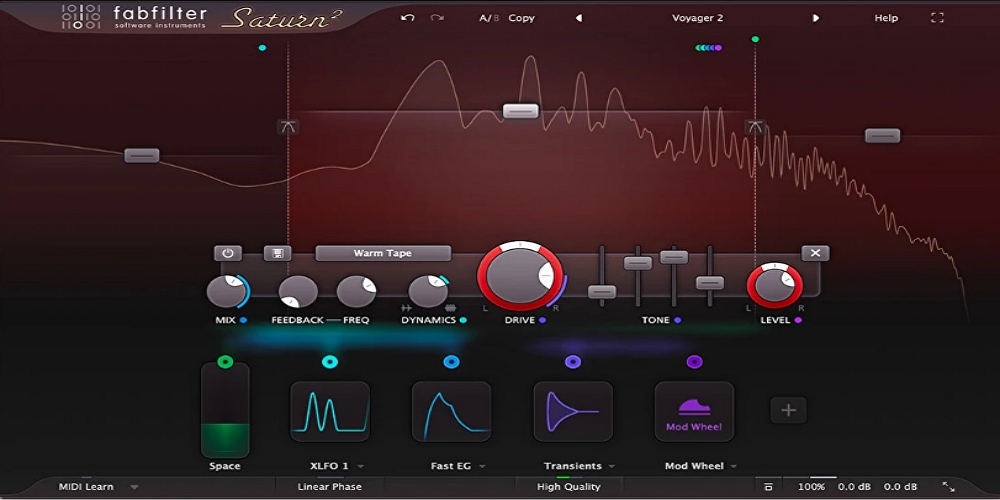
Against FabFilter Saturn 2 ($149), PSP Saturator is the more focused tool. Saturn 2 offers up to six bands, 28 distortion styles, deep modulation with LFOs and envelope followers, and up to 32x oversampling. It is a sound design powerhouse. But that feature depth comes with significantly higher CPU demands and a learning curve that can slow down mixing sessions. PSP Saturator’s three-engine approach delivers frequency-targeted processing with a fraction of the complexity, and its frequency-dependent tonal shifting sounds more natural on full mixes and bus processing.
Against Soundtoys Decapitator ($199), PSP offers better technical foundations at half the price. Decapitator famously lacks built-in oversampling, producing documented aliasing at standard sample rates. PSP’s FAT mode addresses this directly. Decapitator counters with more immediately characterful hardware modeling and its iconic Punish button, making it better suited for aggressive creative effects. For transparent-to-warm saturation across a mix, PSP has the edge.
Against Softube Harmonics ($149), the key differentiator is Softube’s Dynamic Transient Control technology, which preserves transient punch even under heavy saturation. PSP lacks this feature but offers superior frequency targeting through its three independent engines and stronger anti-aliasing through FAT. Against Kazrog KClip 3 ($69), the tools serve different purposes entirely. KClip is a mastering-grade clipper focused on transparent loudness gain, while PSP Saturator is built for harmonic enrichment and analog coloring.
PSP Saturator is built for mixing and mastering engineers who value musical, analog-inspired saturation over flashy sound design features. If your workflow involves adding warmth to individual tracks, gluing a mix bus with subtle tape-style processing, or enhancing low-end weight on bass and drums, this plugin belongs on your shortlist. It pairs particularly well with other PSP tools like the Impressor compressor, and long-term users on Gearspace and KVR consistently report that it has replaced multiple saturation plugins in their workflow.
Producers working primarily in electronic music or sound design who need heavy modulation, multiband splitting, and extreme distortion effects may find Saturn 2 a better fit. But for anyone prioritizing sound quality, CPU efficiency, and that elusive analog feel, PSP Saturator punches well above its $99 price point.
PSP Saturator retails for $99 and is regularly discounted to around $59 during PSP’s periodic sales. It is also available within the PSP 25th Anniversary Bundle (25 plugins for approximately $499), which represents significant savings for users interested in the broader PSP ecosystem. A fully functional 30-day trial with no feature restrictions is available, giving you ample time to test it on real projects before committing.
PSP Saturator is not the most feature-packed saturation plugin available, and it does not try to be. What it does offer is a thoughtfully engineered three-engine architecture that mirrors how analog hardware actually saturates audio, eight distinct shape modes that cover everything from transparent warming to aggressive clipping, effective anti-aliasing through FAT oversampling, and a hidden control panel that rewards deeper exploration. At $99, it competes with and often outperforms plugins costing significantly more. If you are looking for a single saturation tool that can handle subtle mix bus warmth, targeted low-end enhancement, and creative vocal processing with equal confidence, PSP Saturator belongs at the top of your list.