 11
11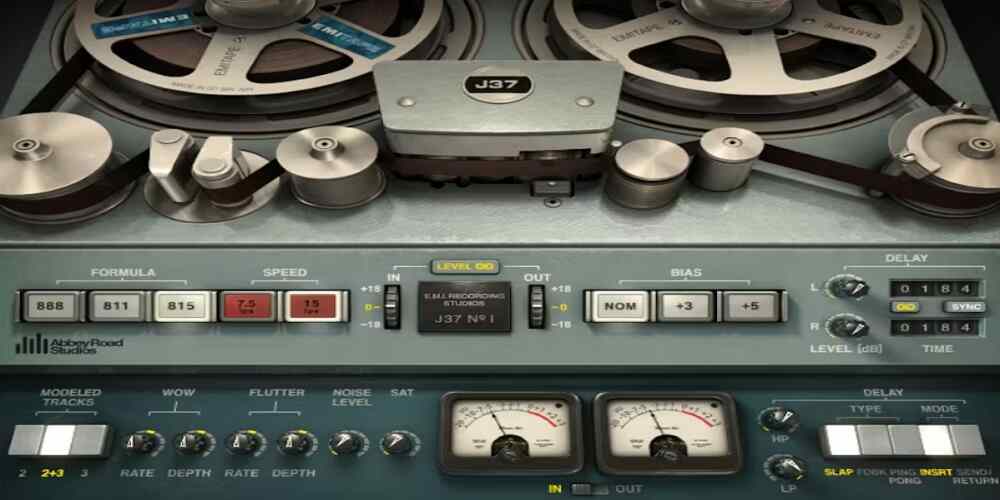
Baby Audio TAIP, the UAD Ampex ATR-102, and Softube Tape lead a field of the best tape emulation plugins in 2026, each excelling in distinct use cases from AI-driven creative saturation to forensically accurate mastering-grade processing. The tape plugin landscape has shifted dramatically: UAD’s flagship emulations now run natively without proprietary hardware, neural network modeling has matured into a legitimate alternative to traditional DSP, and free options like Chow Tape Model rival commercial competitors.
Whether you need transparent mix-bus glue, multitrack warmth, lo-fi cassette degradation, or mastering polish, there has never been a better — or more affordable — time to add analog tape character to your digital workflow.
Tape emulation remains one of the most universally applied processing categories in modern music production. These plugins model the harmonic saturation, soft-knee compression, frequency response quirks, and mechanical imperfections of analog tape machines — the cumulative effect being recordings that feel warmer, more cohesive, and less “digital.” The 10 plugins below represent the best options available in 2026, selected after evaluating sound quality, value, CPU efficiency, feature depth, and professional consensus across major publications and user forums.
Check The Top Tape Emulation Plugins
| Plugin | Developer | Price | Best For | CPU Load |
| Ampex ATR-102 | Universal Audio | $349 (often $29–$49 on sale) | Mastering & mix bus | Heavy |
| Studer A800 | Universal Audio | $299 (often $14–$46 on sale) | Multitrack processing | Moderate |
| TAIP | Baby Audio | $99 (often $10–$25 on sale) | AI-powered saturation | Moderate-High |
| Tape | Softube | $99 (often $29–$39 on sale) | CPU-efficient every-track use | Very Light |
| Abbey Road J37 | Waves | $149 (often $29–$40 on sale) | Tape delay & vintage color | Moderate-High |
| Virtual Tape Machines | Slate Digital | $149 or All Access sub | Analog workflow simulation | Moderate |
| T-RackS Tape Collection | IK Multimedia | $199 (often $49 on sale) | Maximum variety (4 machines) | Heavy |
| P821 MDN Tape | Pulsar Modular | $179 | Transformerless tape character | Moderate |
| Cassette | Wavesfactory | €59 (~$65) | Authentic cassette emulation | Light |
| Chow Tape Model | Chowdhury DSP | Free | Best free tape plugin | Light-Moderate |
Tape emulation plugins do far more than add “warmth” — a term so overused it has nearly lost all meaning. What actually happens when audio passes through a modeled tape machine involves multiple simultaneous processes that collectively transform the character of a recording.
Harmonic saturation is the most obvious effect. Tape introduces new overtones musically related to the original signal, enriching thin digital recordings with density and presence. Unlike hard digital clipping, tape produces soft clipping that compresses peaks gracefully — what engineers call natural tape compression. This soft-knee behavior tames transients without the pumping artifacts of a compressor, making drums hit harder while sounding less spiky. At higher drive levels, tape generates predominantly odd-order harmonics (3rd, 5th), though the full signal path — transformers, tubes, transistors, and the magnetic medium itself — creates a uniquely layered harmonic profile distinct from any single-stage saturation type.
The frequency response changes are equally important. Tape machines exhibit a characteristic low-frequency boost called “head bump” that varies by tape speed: 7.5 IPS produces the warmest, most colored sound; 15 IPS delivers the classic studio balance; 30 IPS keeps things tight and extended. High frequencies naturally roll off, softening harsh digital brightness without surgical EQ. And crosstalk between channels subtly blends the stereo image, creating the perceived “width” and “depth” that makes tape-processed mixes sound three-dimensional.
The cumulative result of running a full mix through tape emulation — what producers call “glue” — comes from every element sharing the same saturation profile, compression characteristics, and frequency shaping. This shared processing creates cohesion that is difficult to achieve any other way, which is precisely why tape emulation remains a staple on mix buses and mastering chains worldwide.
Developer: Universal Audio | Price: $349 MSRP (often $29–$49 on sale; included in UAD Spark at $19.99/mo or $79/yr promo) | Best For: Mastering and mix bus processing
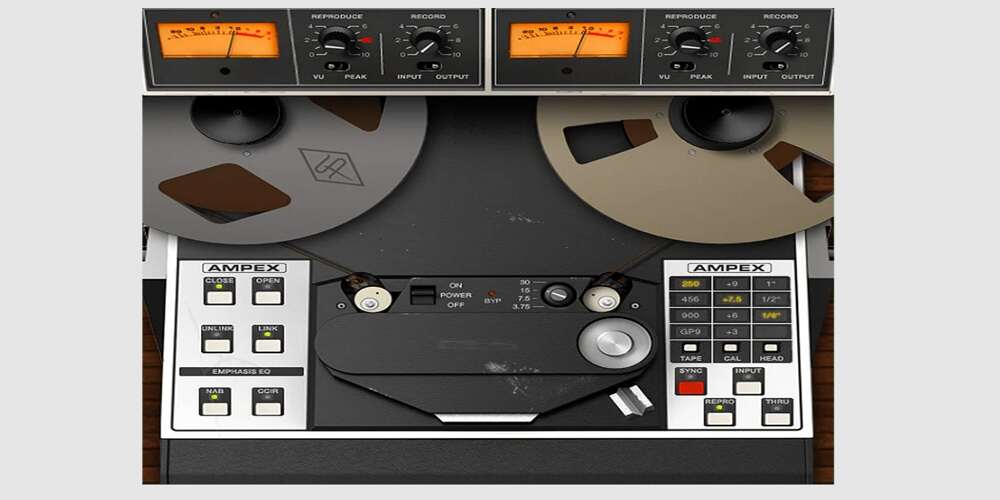
Universal Audio’s emulation of the legendary Ampex ATR-102 stereo mastering deck holds a 4.9 out of 5 rating from over 1,100 reviews and remains the benchmark against which all mix-bus tape plugins are measured. The original ATR-102, introduced at the 1976 AES Conference, was a servo-controlled two-channel recorder so ubiquitous in professional studios that it would be easier to list classic albums that were not mixed down on this machine.
The plugin’s depth is staggering. Seven tape formulations (including GP9, Ampex 456, BASF 900, and 3M 250), four tape speeds (3.75 to 30 IPS), three head widths (1/4”, 1/2”, 1”), individually adjustable hiss, hum, wow, flutter, and crosstalk, plus a toggleable transformer model and built-in tape delay. Opening the “lid” reveals a full calibration panel replicating every adjustment available on the hardware. An Auto-Gain feature addresses the common complaint about manual output compensation.
The most significant development for the ATR-102 is that it now runs fully natively on macOS and Windows without any UAD hardware. Through the UAD Spark subscription ($19.99/month, $149.99/year, or a current promotional rate of $79/year), both the ATR-102 and Studer A800 are accessible to anyone. Perpetual licenses carry a $349 MSRP but regularly drop to $29–$49 during sales. Its primary weakness is CPU intensity — this is a mix-bus and mastering plugin, not one you would place on every channel.
Pro Tip: Pair the ATR-102 on your stereo bus with the Studer A800 on individual channels for the complete analog tape workflow. Start with the 30 IPS / 456 combination for clean punch, then experiment with slower speeds for more pronounced coloration.
Developer: Universal Audio | Price: $299 MSRP (often $14–$46 on sale; included in UAD Spark) | Best For: Channel-strip tape processing across entire sessions
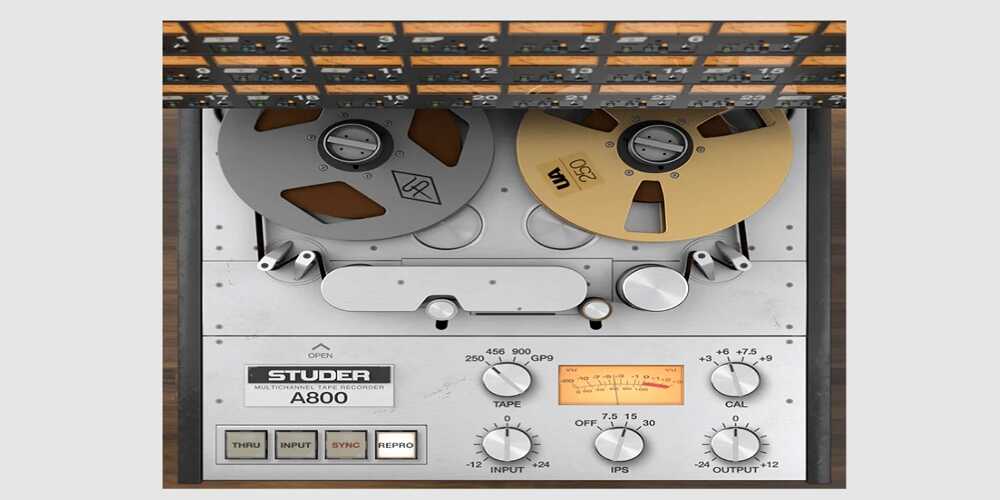
Where the ATR-102 sits on the stereo bus, the Studer A800 goes on every track. This emulation of the 900-pound, 24-track Studer A800 — the first microprocessor-controlled tape machine, introduced in 1978 — was modeled from Allen Sides’ personal unit at Ocean Way Studios with authentication from Studer and input from magnetic recording expert Jay McKnight.
Four tape formulations (3M 250, Ampex 456, BASF 900, Quantegy GP9), three speeds (7.5, 15, 30 IPS), multiple EQ emphasis curves, and calibration levels give enormous tonal flexibility. The Gang Controls feature links all plugin instances so adjustments propagate across an entire mix — essential for the intended workflow of placing the A800 on every channel to simulate tracking to tape. The A800 is lighter on CPU than the ATR-102, designed specifically for multi-instance use.
Pro Tip: Use the Gang Controls feature to apply uniform tape character across your entire session, then individually tweak drums and bass to taste. The 15 IPS / 456 combination delivers a classic rock warmth that is hard to beat.
Developer: Baby Audio | Price: $99 MSRP (frequently $10–$25 on sale) | Best For: Versatile, intuitive tape saturation across any genre
TAIP represents a fundamentally different approach to tape emulation. Rather than mathematically modeling individual analog components, Baby Audio trained a neural network on audio processed through a 1970s reel-to-reel machine — feeding sine sweeps and white noise through the hardware and teaching the AI to learn the exact nonlinear behaviors, harmonic characteristics, and dynamic responses of real tape. The result captures quirks and interactions that traditional DSP approximates but never fully replicates.
The interface is deliberately streamlined. Drive controls saturation intensity, Glue exaggerates tape’s natural compression (functioning as a de facto compressor), Wear combines wow, flutter, and frequency response degradation, and Presence manages high-frequency attenuation. Hi-Shape and Lo-Shape controls let you target saturation to specific frequency ranges. A Dual mode chains two virtual tape machines in series for extra weight. Sound On Sound described it as a versatile plugin that punches well above its price point.
Pro Tip: TAIP’s Glue control is an underrated secret weapon on drum buses. Set Drive at 30–40%, push Glue to 50–60%, and you get natural-sounding bus compression without ever touching a compressor plugin.
Developer: Softube | Price: $99 MSRP (commonly $29–$39 on sale) | Best For: Running tape emulation on every track without CPU strain
Softube Tape solves a practical problem that plagues many tape plugins: you can actually put it on every single track without your CPU melting. Using component-level and physical modeling, it offers three tape machine types — Type A (precision Swiss machine, likely Studer-inspired), Type B (transformer-based, likely Ampex-inspired), and Type C (British vintage, likely EMI/Abbey Road-inspired) — with five tape speeds from 30 IPS down to 1⅞ IPS.
The Amount knob provides single-control simplicity, while the Remote Control panel reveals deeper parameters: Speed Stability (wow and flutter), High Frequency Trim, Crosstalk modeling, and a Tape Stop effect. For PreSonus Studio One users, the Tape Multitrack mode in the MixFX slot enables selectable crosstalk between individual tracks — a unique integration no competitor offers. Grammy-winning presets from Joe Chiccarelli (Beck, U2) and Howard Willing (Smashing Pumpkins) provide professional starting points.
Pro Tip: Try Type C at 15 IPS for guitars and vocals where you want noticeable character, and Type A at 30 IPS on cleaner sources like pianos and acoustic instruments where subtlety is key.
Developer: Waves | Price: $149 MSRP (routinely $29–$40 on sale; included in Waves Creative Access) | Best For: Vintage character and tape delay effects
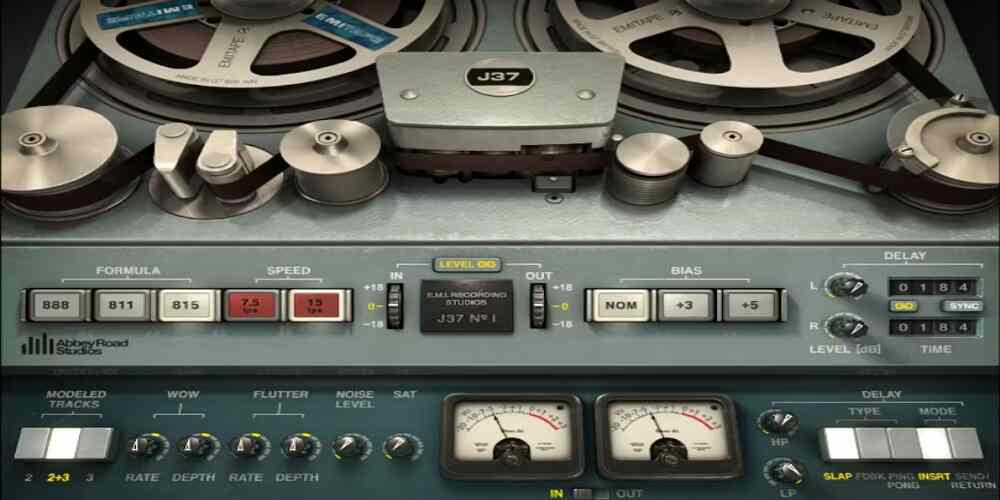
The J37 emulates the Studer J37 four-track machine used at Abbey Road Studios — the recorder that captured the Beatles’ Sgt. Pepper’s Lonely Hearts Club Band. Developed in partnership with Abbey Road, it offers three EMI oxide tape formulas: EMI 888 (aggressive 1960s character), EMI 811 (balanced mid-1960s), and EMI 815 (refined 1970s).
What sets the J37 apart is its comprehensive tape delay section — three delay types (slap, feedback, ping-pong), BPM sync, independent left/right control, and high/low-pass filtering. This makes it simultaneously a tape emulation and a creative effects tool. The Level Link feature enables gain-compensated saturation driving, solving the common problem of output volume jumping when increasing tape drive.
Pro Tip: Use the J37’s slap delay setting on a send for snare ambience. A 40–80ms delay with light tape saturation creates a quick, dirty space around the snare that cuts through the mix without the muddiness of a long reverb tail.
Developer: Slate Digital | Price: $149 standalone or All Access Pass ($12.49–$19.99/mo) | Best For: Producers who want a complete analog workflow
Virtual Tape Machines models two specific machines: a 2-inch 16-track from NRG Recording Studios and a 1/2-inch stereo mastering deck from Howie Weinberg Mastering. Two tape formulations and speeds of 15 and 30 IPS keep things simple. Producer Dave Schiffman, known for his work with bands like Nine Inch Nails and Weezer, has stated his real ATR-102 has not been turned on since he started using VTM.
VTM’s real value proposition is the Slate Digital All Access Pass at $12.49–$19.99/month, which includes 80+ plugins alongside VTM. Paired with Slate’s Virtual Console Collection, it creates a complete analog signal chain emulation. The standalone price of $149 is reasonable but less compelling given the subscription’s breadth.
Pro Tip: For the most realistic analog workflow, pair VTM with Slate’s Virtual Console Collection. Put the 16-track machine on individual channels and the 1/2-inch mastering deck on your stereo bus.
Developer: IK Multimedia | Price: $199 MSRP (frequently $49 on sale) | Best For: Maximum tonal variety from a single purchase
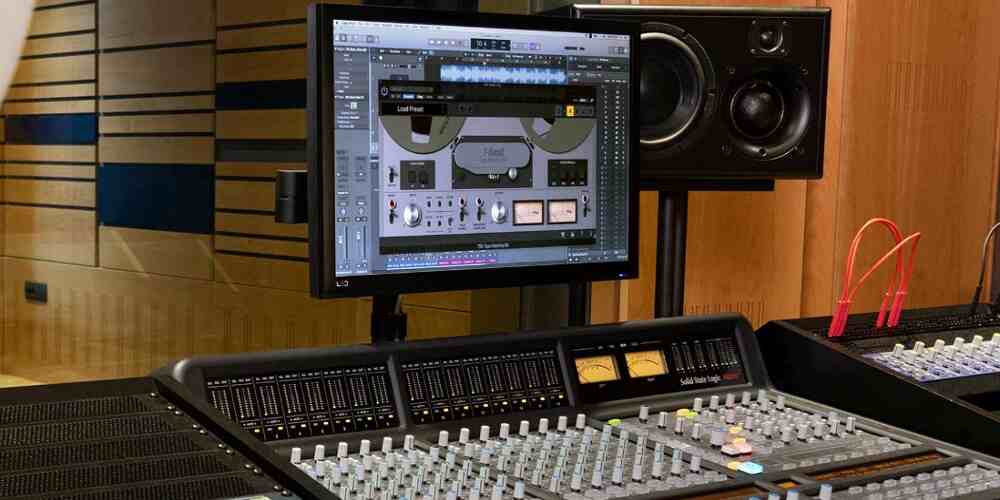
This collection bundles four distinct tape machine emulations, each representing a different era and philosophy of tape recording: the Ampex 440B (soulful 1960s American mixdown character), Studer A80 Mk II (transparent 1970s Swiss workhorse), MCI JH24 (pristine 1980s transformerless design), and Revox PR99 Mk II (smooth 1980s broadcast quality). Each machine offers four tape formulations (250, 456, GP9, 499), creating 16 unique machine-tape combinations.
IK’s hybrid approach — combining dynamic convolution with physical modeling at up to 384 kHz internal processing — delivers remarkable authenticity. True Stereo modeling recreates subtle left/right channel differences found in real machines. The photo-realistic UI with spinning reels that change appearance by tape type adds a visual dimension that enhances the creative experience.
Pro Tip: The Ampex 440B with 456 tape at 15 IPS is outstanding for warming up thin vocal recordings. The MCI JH24 at 30 IPS offers the cleanest tape sound in this collection — ideal for modern pop and electronic genres where you want subtle cohesion without obvious coloration.
Developer: Pulsar Modular | Price: $179 | Best For: Capturing authentic transformerless tape character
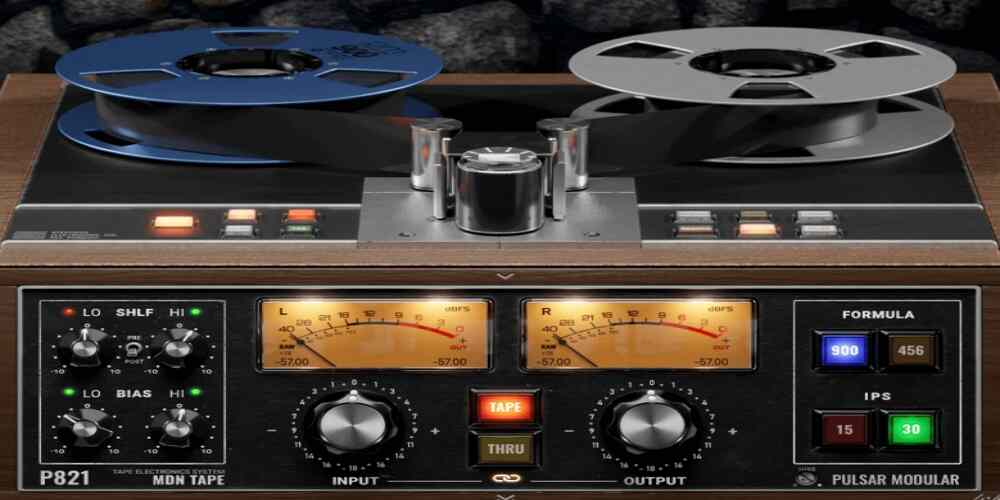
Released in April 2025, the P821 MDN Tape emulates Marc Daniel Nelson’s personal Stephens 821 two-inch machine — the recorder used at Producer’s Workshop for seminal albums including Pink Floyd’s The Wall, Steely Dan’s Aja, and Fleetwood Mac’s Rumours. What makes this emulation unique is its focus on the Stephens’ transformerless design, capturing how the tape medium itself behaves without the coloration of surrounding electronics.
Features include two tape formulas (900 and 456), 15/30 IPS speeds, pre/post shelving EQ, bias controls, a tape delay circuit with feedback, and wow and flutter with tape flanging. Professional endorsements from Dave Pensado, Darrell Thorp, and Ryan Freeland lend significant credibility. Updated to v1.2.5 in March 2026, the P821 represents the most interesting new entry in the reel-to-reel emulation space.
Pro Tip: The 900 tape formula at 30 IPS offers a distinctly open, uncolored tape sound that works beautifully on acoustic and jazz recordings where transparency is paramount. Switch to 456 at 15 IPS when you want the classic rock warmth.
Developer: Wavesfactory | Price: €59 (~$65, frequently on sale around $29) | Best For: Authentic cassette character for lo-fi and bedroom pop
Cassette emulation occupies a fundamentally different sonic territory than reel-to-reel. Where professional tape machines were engineered for maximum fidelity, cassette decks running at 1⅞ IPS on 1/8-inch tape produced pronounced wow and flutter, limited bandwidth, audible hiss, and heavy saturation — imperfections that define the lo-fi aesthetic driving genres from bedroom pop to lo-fi hip-hop.
Wavesfactory Cassette models all four real cassette tape formulations: Type I (Ferric Oxide, warm and gritty), Type II (Chromium Dioxide, better high-frequency response), Type III (Ferro-Chrome, rare hybrid), and Type IV (Metal, firmest bass and extended highs). A “Pro” versus “Micro” player toggle switches between a high-quality audiophile deck and a portable Walkman-style player. The hidden settings panel reveals deep controls including the unique “Re-Cassette” parameter, which simulates multiple generations of tape dubbing — the sonic equivalent of copying a copy of a copy.
Pro Tip: For subtle vintage warmth rather than obvious lo-fi, use Type II tape on the Pro player with minimal wow and flutter. For full-blown 4-track demo vibes, switch to Type I on the Micro player and push the input.
Developer: Chowdhury DSP | Price: Free (open source) | Best For: Anyone on a budget, and honestly, everyone else too
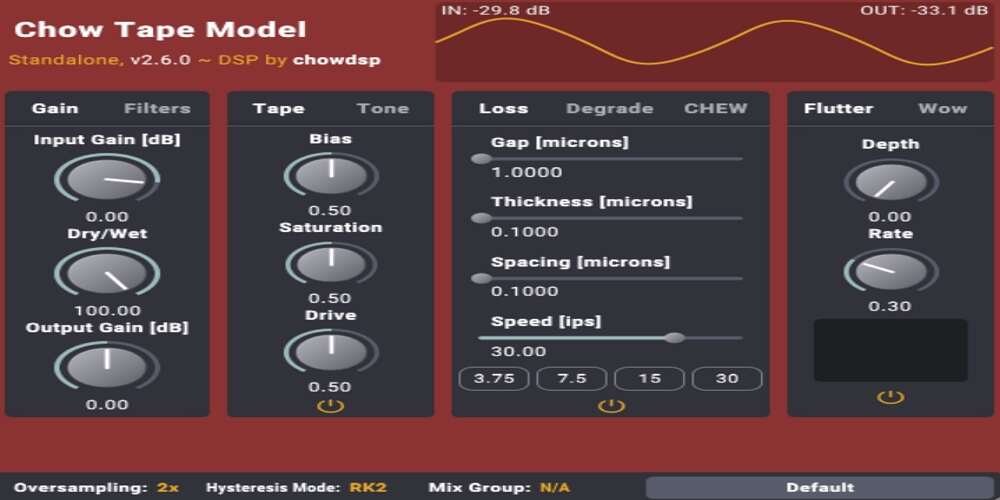
Originating as a Stanford University class project and published at the 2019 DAFx Conference, Chow Tape Model has earned a perfect 5.0/5.0 rating on KVR Audio and routinely draws comments comparing it favorably to commercial plugins costing 10 to 20 times more. It is, without qualification, the best free tape emulation plugin available.
The feature list is remarkable for any plugin, let alone a free one: adjustable tape speed (3.75 to 30 IPS), multiple hysteresis models including neural network mode, up to 16x oversampling, linear phase processing, degradation effects (“Chew” with envelope and variance controls), independent wow and flutter with drift parameters, loss filter modeling with azimuth control, tape compression, input sidechain filtering, mix groups for syncing instances, and stereo/mid-side balance. Formats include VST, VST3, AU, AAX, CLAP, LV2, and even iOS AUv3 — with Linux support via LV2, something no commercial tape plugin offers.
Developer Jatin Chowdhury based the modeling on a Sony TC-260 reel-to-reel, using physical modeling techniques documented in his academic paper. The current version (2.11.4) is stable, mature, and also distributed through MuseHub.
Pro Tip: Start with the “NRK8” hysteresis mode for the most accurate emulation. Set oversampling to 4x or 8x for critical mixing work. The “Chew” effect at very low settings adds a realistic tape degradation that expensive plugins struggle to match.
Several plugins did not make the top 10 but deserve attention depending on your specific needs. Aberrant DSP SketchCassette II ($36) offers 12 unique tape-and-quality profiles with outstanding wow and flutter controls — more creative and versatile than Wavesfactory Cassette for experimental work, though less realistic. Soundtoys Decapitator ($199, often $59–$69 on sale) is not a tape emulation per se, but its Style “A” mode models an Ampex 350 tube tape machine and delivers superb tape-flavored saturation. XLN Audio RC-20 Retro Color ($99, currently $39.60) is a broader vintage color multi-effect rather than a dedicated tape plugin, but its saturation, wobble, and degradation modules make it a lo-fi production staple.
Fuse Audio Labs TCS-68 ($59) faithfully emulates the Tascam Midistudio 688 cassette multitracker for authentic 4-track demo-tape character. Acustica Audio Taupe Studio (€189, released May 2025) brings 27 tape profiles sampled from five iconic machines, though CPU demands are substantial. Among free options beyond Chow Tape, Caelum Audio Tape Cassette 2 provides a capable cassette emulation with real sampled noise and modulated wow and flutter, while Airwindows ToTape6 offers zero-latency tape processing from developer Chris Johnson’s prolific donationware catalog.
The distinction between these two categories is not merely one of fidelity — it is a fundamental difference in intent. Reel-to-reel emulations model professional machines that were engineered to be as transparent as possible; their coloration is a byproduct of the medium, not a deliberate effect. Running audio through a UAD Studer A800 or Softube Tape adds subtle saturation, gentle compression, and frequency shaping that enhances without drawing attention to itself. These plugins are mixing and mastering tools.
Cassette emulations, by contrast, model consumer-grade hardware running at drastically slower speeds on narrower tape. The pronounced wow and flutter, bandwidth limitations, audible hiss, and heavy saturation are the point. Wavesfactory Cassette and SketchCassette II are creative effects tools, not transparent processors. Choose reel-to-reel for professional polish; choose cassette for deliberate lo-fi texture.
If you plan to use tape emulation on every track, CPU efficiency becomes the primary constraint. Softube Tape is explicitly designed for this workflow and remains the lightest option. Chow Tape Model and Fuse Audio Labs Flywheel also handle multi-instance use well. At the opposite extreme, IK Multimedia’s Tape Machine Collection and Acustica Audio’s Taupe are CPU-intensive enough that users describe them as designed for mastering rather than mixing.
Latency matters most during tracking. Airwindows ToTape6 (free, zero latency) and Softube Tape (very low latency) work for real-time monitoring. Most other tape plugins introduce enough latency that they are best applied during mixing, where DAW delay compensation handles the offset automatically.
The plugin industry’s subscription landscape has settled into a pragmatic equilibrium. UAD Spark at $79/year (current promotional rate) provides access to both the Studer A800 and Ampex ATR-102 alongside 60+ other premium plugins — extraordinary value for anyone who would otherwise spend $600+ on perpetual licenses. Slate Digital’s All Access Pass ($12.49–$19.99/month) bundles VTM with 80+ plugins. Waves Creative Access ($14.99–$24.99/month) includes both J37 and Kramer Master Tape.
Community sentiment overwhelmingly favors perpetual licensing, and every major developer now offers both options after significant user backlash against subscription-only models. The practical advice: subscriptions make sense for exploration and short-term projects; perpetual licenses (purchased during frequent deep sales) make sense for plugins you will use for years.
The tape emulation market in 2026 offers genuine quality at every price point, from Chow Tape Model’s free Stanford-engineered physical modeling to UAD’s forensically accurate $349 Ampex ATR-102. The most important insight from this research is that no single tape plugin is “best” — the right choice depends entirely on where and how you will use it.
The UAD ATR-102 remains unmatched for stereo-bus mastering polish. Baby Audio TAIP delivers the most musical results with the least effort. Softube Tape is the only plugin practical enough for 50+ simultaneous instances. Wavesfactory Cassette owns the cassette emulation category. And Chow Tape Model proves that open-source software can compete with — and sometimes surpass — commercial offerings.
The broader trend is toward accessibility. Neural network modeling, native processing without proprietary hardware, aggressive subscription pricing, and increasingly capable free alternatives have collectively demolished the barriers that once made quality tape emulation a luxury. The technology that once required a 900-pound machine and a maintenance budget now lives inside a plugin — and often sounds close enough that professionals cannot tell the difference.
Other Guides