 11
11 Distortion is no longer a mistake to be corrected. In the context of modern mixing, it is one of the most versatile tools available for adding warmth, harmonic depth, and presence to any signal. Whether you are thickening a vocal, gluing a drum bus, or giving a lifeless synth pad some character, the right distortion plugin can transform a flat mix into something that feels alive and three-dimensional.
The challenge is choosing the right one. The market is packed with options ranging from simple one-knob saturators to deep multiband processing environments with modulation matrices and convolution engines. Some excel at subtle, transparent warmth. Others are built for aggressive creative destruction. Many try to do both.
This guide covers nine of the best distortion VST plugins for mixing in 2026. Every plugin on this list has been evaluated specifically for mixing applications, not just sound design or guitar processing. That means we are looking at how well each tool handles bus saturation, parallel distortion, harmonic enhancement, frequency-targeted processing, and integration into real mixing workflows. We have also included a comparison table, buying guidance, and a detailed FAQ section to help you make the right investment for your studio.
| Plugin | Price | Sale Price | Types | Multi-band | Modulation | Mix Knob | Free Tier | Formats | Best Mixing Use |
| FabFilter Saturn 2 | $154 | Rare | 28 | 6-band | Deep | Per-band | No | VST/3, AU, AAX, CLAP | All-purpose multiband |
| Soundtoys Decapitator | $199 | $49–69 | 5 | No | None | Yes | No | VST/3, AU, AAX | Instant analog character |
| Arturia Dist COLDFIRE | $99 | $49–69 | 22 | Band split | 6 slots | Yes | No | VST/3, AU, AAX | Creative routing |
| Ohmforce Ohmicide[S] | €99 | N/A | 111 | Yes | 8 sources | Yes | No | VST/3, AU, AAX | Deep multiband |
| Black Box HG-2 | $249 | $29.99 | 4 | No | None | Yes | Sub | VST/3, AU, AAX | Mix bus / mastering |
| Minimal Audio Rift 2.0 | $129 | $59–79 | 30 | Yes | Curves | Yes | Trial | VST/3, AU, AAX | Electronic mixing |
| United Plugins Cyberdrive | $92 | €39 Core | 64 | Per-module | Random | AGC | Core | VST/3, AU, AAX | All-in-one workstation |
| iZotope Trash | $99 | $19–29 | 60+ | 3-band | Env | Yes | Lite | VST3, AU, AAX | Convolution texture |
| Eventide CrushStation | $99 | $19 | Cont. | No | Ribbon | Yes | Was free | VST/3, AU, AAX | Best value |
AGC = Automatic Gain Compensation. Cont. = Continuous range (no discrete algorithm count). Sub = Available via subscription.
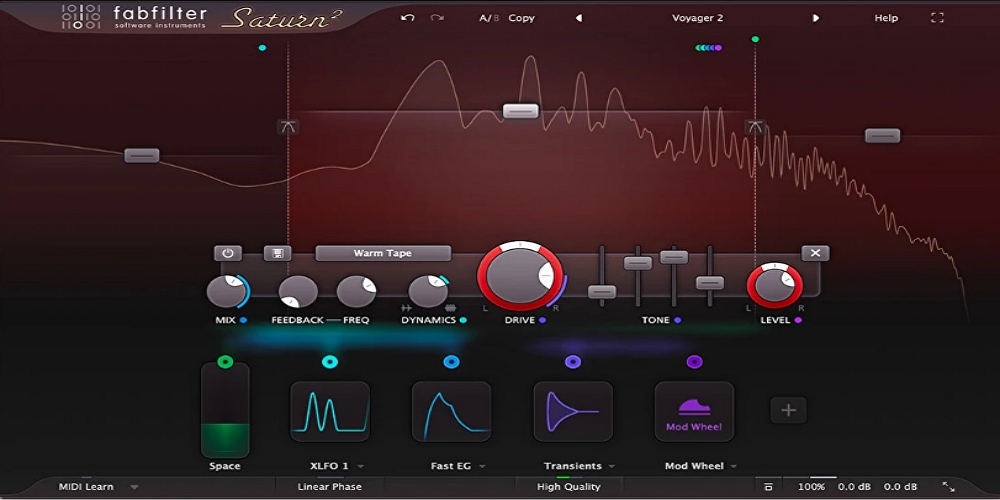
FabFilter Saturn 2 is the benchmark against which every other distortion plugin is measured, and for good reason. It combines an exceptionally clean interface with a processing depth that ranges from transparent mastering-grade saturation to complete harmonic destruction, all within a single plugin.
Saturn 2 provides up to six fully independent frequency bands, each with its own distortion type, drive amount, dynamics processing, feedback, tone shaping, and mix control. This means you can apply gentle tape saturation to your low end, subtle tube warmth to your midrange, and aggressive transformer grit to your high frequencies, all within one instance. The crossover slopes are adjustable at 6, 12, 24, or 48 dB per octave, giving you precise control over how the bands interact.
The 28 distortion styles span tube, tape, amplifier, transformer, and creative categories including Foldback, Rectify, and Destroy. Each algorithm responds differently to gain staging, which means even a single style can produce a wide variety of tones depending on how hard you push it.
The modulation system is where Saturn 2 truly separates itself from the competition. Every parameter can be modulated via drag-and-drop using XLFOs, envelope generators, envelope followers, XY controllers, and MIDI sources. The real-time visualization shows modulation activity directly on the controls, making it easy to understand exactly what is happening at any moment. This is particularly useful when creating rhythmic saturation effects or dynamic distortion that responds to the input signal.
On a drum bus, Saturn 2 can add punch and body without sacrificing transient detail. On vocals, the Subtle mode applies gentle harmonic enhancement that helps a performance sit forward in the mix without sounding processed. On the master bus, the linear phase mode ensures that multiband processing does not introduce phase smearing. The built-in HQ mode offers 8x and 32x oversampling for critical applications where aliasing must be minimized.
At $154, Saturn 2 is one of the more expensive options on this list, though FabFilter rarely discounts its products. The plugin is also CPU-intensive when using multiple bands with high oversampling settings. The preset browser, while functional, lacks the tagging and search capabilities found in newer competitors. Despite these minor drawbacks, Saturn 2 remains the most versatile and capable multiband distortion plugin available.
Formats: VST, VST3, AU, AAX, CLAP. macOS and Windows.
Price: $154 (perpetual license).
Soundtoys Decapitator has been a fixture in professional studios since its release in 2009, and its longevity speaks to the quality of its sound. While it lacks the multiband processing and modulation features of modern competitors, no other plugin on this list delivers analog-modeled saturation with as much speed and musical quality.
Decapitator offers five distinct saturation models, each based on a real piece of analog hardware. The A model is based on an Ampex 350 tape preamp and delivers smooth, warm saturation with a gentle high-frequency rolloff. The E model draws from a Chandler/EMI console channel and produces a punchy, aggressive character that excels on drums. The N model is inspired by a Neve 1057 and offers a thick, rich saturation with a pronounced midrange presence. The T and P models emulate two configurations of the Thermionic Culture Vulture, delivering increasingly aggressive harmonic content.
Decapitator thrives as a channel strip saturator. Placing it on individual tracks before the mix bus adds the kind of cumulative analog warmth that is difficult to achieve any other way. On vocals, the N model at low drive settings adds presence without harshness. On bass, the A model thickens the low midrange and helps the instrument translate on smaller speakers. The Mix knob enables parallel saturation directly within the plugin, eliminating the need for auxiliary routing.
The Punish button engages an additional gain stage that pushes the signal harder into the saturation circuit. This is particularly effective on drum overheads and room microphones where you want the saturation to become an audible part of the texture.
Decapitator has not received a major feature update since its original release. The interface is not resizable and does not support HiDPI displays natively. There is no multiband processing, no modulation, and no sidechain input. At $199 full price it is expensive for a single-purpose plugin, but Soundtoys runs frequent sales that bring it down to $49–69, making it an excellent value at the discounted price. It requires an iLok account, though a physical dongle is no longer necessary.
Formats: VST2, VST3, AU, AAX. macOS and Windows.
Price: $199 (frequently $49–69 on sale). Also included in the Soundtoys 5 Bundle.
Arturia Dist COLDFIRE is one of the most feature-dense distortion plugins available, combining a dual-engine architecture with flexible signal routing, deep modulation capabilities, and built-in dynamics processing. It occupies a unique position between Saturn 2 and dedicated sound design tools, offering enough depth for experimental work while remaining practical enough for everyday mixing.
COLDFIRE provides two independent distortion engines, each offering 11 algorithms that span analog emulations (tube, tape, transistor, transformer, germanium), digital processing (bit crusher, bit inverter, wavefolder, waveshaper, rectifier), and a force mode. The two engines can be routed in five different configurations: serial, parallel, stereo left/right split, mid/side, and band split with an adjustable crossover frequency.
This routing flexibility is COLDFIRE’s strongest mixing feature. The mid/side mode lets you apply warm analog saturation to the center of your mix while adding sharper digital edge to the sides. The band-split mode enables frequency-targeted processing similar to a multiband setup, though with only two bands rather than Saturn 2’s six.
The modulation system offers six slots that can host LFOs, function generators, envelope followers, and 16-step sequencers. Nearly every parameter in the plugin can be a modulation target, including parameters on other modulators for complex interconnected behaviors. For mixing, the envelope follower is particularly useful because it allows the distortion character to respond dynamically to the input signal, creating results that feel more organic than static processing.
COLDFIRE’s depth is both its strength and its potential weakness. The learning curve is steeper than any other plugin on this list except perhaps Ohmicide[S]. CPU usage runs higher than average, particularly in its Render quality mode. The lack of a dark mode is a minor but persistent complaint. At $99 standalone or as part of Arturia’s FX Collection 6, it represents excellent value for the feature set offered.
Formats: VST2, VST3, AU, AAX. macOS and Windows.
Price: $99 standalone (frequently $49–69 on sale). Also available in Arturia FX Collection 6.
The original Ohmicide, released in 2007, was a landmark plugin that influenced an entire generation of distortion tools, including Ableton’s own Roar effect. After nearly two decades offline, Ohmforce rebuilt the plugin from scratch and released Ohmicide[S] in July 2025. The result is the most algorithmically rich distortion plugin on the market, with 111 distortion algorithms organized across three processing families.
Ohmicide[S] offers 37 base distortion types, each available in three modes: Standard (clean, faithful processing), XXX (analog-like warmth and compression), and ODD (broken, experimental, unpredictable). The types span three families. Classics includes emulations of amplifiers, consoles, and turntables. Edgy provides aggressive cubic and V-shaped clipping curves. Wacky delivers experimental processing including time-freeze effects and unusual waveshaping.
The multiband system is more sophisticated than any competitor. You can split the signal by frequency or use parallel processing, and a dedicated low-end X band remains available at all times to protect sub-bass content from unwanted distortion artifacts. Each band has its own distortion engine, noise gate, dynamics processor, multimode filter, and feedback section. The signal chain within each band can be rearranged via a pre- and post-routing matrix.
Eight modulation sources including envelopes, envelope followers, LFOs, and step sequencers can target any parameter in the plugin. Four customizable macro controllers with unlimited parameter mapping and adjustable response curves provide performance-ready control. This makes Ohmicide[S] capable of creating dynamic, evolving distortion textures that change over time rather than remaining static.
As a July 2025 release, Ohmicide[S] is still maturing. The wide interface may feel cramped on smaller displays, and some users have requested collapsible panels. The 30-minute demo includes periodic noise, which makes extended evaluation difficult. At €99, it is priced competitively given its depth, and a bundle with Ohmboyz Infinity is available for €149.
Formats: VST2, VST3, AU, AAX. macOS and Windows.
Price: €99 (perpetual license).
The Black Box Analog Design HG-2 is a plugin emulation of a $3,500+ hardware tube saturation unit, developed in collaboration between Black Box Analog Design and Brainworx. It is widely regarded as one of the best mix bus and mastering saturation tools available in software form.
The HG-2 models four vacuum tube stages: a 6U8A pentode, a 6U8A triode, and two 12AX7 tubes operating in a parallel saturation circuit. Separate gain controls for the pentode and triode sections let you blend between different harmonic profiles. The pentode stage produces a brighter, more aggressive saturation with strong odd harmonics, while the triode stage delivers smoother, warmer coloration with even harmonics.
The Air knob adds a subtle high-frequency sheen above 10 kHz that can open up a mix without introducing harshness. The Density control adjusts the overall saturation character from lean and transparent to thick and saturated. A calibration switch offers Dark, Normal, and Bright voicings that shift the tonal center of the saturation. These controls are deliberately simple and focused, which makes the HG-2 an excellent choice for the master bus where small adjustments have significant impact.
The companion HG-2MS plugin adds mid/side processing capabilities, allowing you to apply different saturation amounts to the center and sides of a stereo mix independently. This is particularly valuable in mastering, where you might want to add warmth to the vocal center without affecting the stereo width of reverbs and delays.
The HG-2 is a focused tool with no multiband processing, no modulation, and no built-in dynamics. The $249 list price is misleading because Plugin Alliance runs frequent sales that bring the price down to $29.99, and it is also available through their subscription plans. At its sale price, the HG-2 is one of the best values on this list. At full price, the limited feature set is harder to justify for anyone who does not specifically need high-end mix bus saturation.
Formats: VST2, VST3, AU, AAX. macOS and Windows.
Price: $249 MSRP (frequently $29.99 on Plugin Alliance sales). Available via PA subscription.
Minimal Audio Rift occupies a unique position in the distortion plugin landscape. Its bi-polar processing engine separates the positive and negative halves of a waveform and processes them independently before recombining them. This approach produces harmonic textures that are simply not achievable with conventional clipping or waveshaping algorithms.
Rift’s 30 algorithms are organized into five categories: waveshape, wavefold, noise, bit depth, and custom. Each algorithm can process the upper and lower halves of the waveform with different settings, creating asymmetric distortion profiles that add complex harmonic content. Version 2.0 added multiband processing, allowing you to target the distortion to specific frequency ranges.
The Feedback section is one of Rift’s most distinctive features. It routes the output back through the distortion engine with adjustable delay, creating resonant, pitched feedback effects. The pitch of the feedback can be locked to musical notes and scales using the Pitch Snap tool, and it responds to MIDI input for melodic distortion effects. Twenty-four filter types include standard multimode options alongside more exotic morphing, phaser, vowel, and harmonic filters.
In electronic music mixing, Rift excels at adding texture and movement to static sounds. Bass lines gain harmonic complexity without losing their fundamental weight. Synth pads develop evolving tonal shifts when modulated with the curve sequencer. Drum loops acquire gritty, lo-fi character through the noise and bit-depth algorithms. The Play View provides a simplified interface for quick adjustments, while the Advanced View exposes the full parameter set for detailed work.
Rift’s multiband implementation only processes the middle band as the wet signal, which limits its flexibility compared to Saturn 2 or Ohmicide[S]. It is more oriented toward adding texture and character than delivering warm, transparent analog saturation. The learning curve in Advanced View is significant. At $129 regular price or $4.99 per month on Splice Rent-to-Own, it is accessible at multiple price points.
Formats: VST2, VST3, AU, AAX. macOS and Windows.
Price: $129 (frequently $59–79 on sale). Splice Rent-to-Own: $4.99/month.
United Plugins Cyberdrive is the most algorithm-rich distortion plugin on this list after Ohmicide[S], offering 64 distortion types across eight categories. Released in late 2024 with significant updates through 2025, it has quickly established itself as a serious contender that most competitor roundups have yet to cover.
Cyberdrive provides three stackable distortion modules, each with its own algorithm selection, gain staging, and high-pass/low-pass filtering. The eight algorithm categories span Classic (hardware emulations), Pedal (guitar stompbox models), Amp (amplifier circuits), Modern (multiband companding and wavefolding), Pixel (bit-crushing and glitch), Shape (waveshaping and rectification), Doom (extreme saturation), and Freak (ring modulation, FM synthesis, and spectral processing).
Beyond distortion, Cyberdrive includes a FEED module with synced delay and pitched feedback, plus an FX Arsenal containing dynamics processing, tone shaping, motion effects, Profile cabinet simulations, and Space reverb and delay. This makes it functionally closer to a complete effects processor than a dedicated distortion plugin.
The self-contained nature of Cyberdrive makes it particularly efficient for mixing workflows where you want distortion combined with dynamics and spatial effects without loading multiple plugins. The automatic gain compensation keeps levels consistent as you experiment with different algorithms and drive settings, which is valuable for honest A/B comparisons during mixing decisions.
The sheer number of options can be overwhelming initially. Some of the Classic algorithms sound similar to each other at comparable drive levels, and the plugin can smash transients at higher settings. As a relatively new product, the preset library and community resources are still growing. The licensing is notably user-friendly with no iLok requirement, free lifetime updates, and unlimited computer installations. Cyberdrive Core, a single-module version at €39, provides an affordable entry point.
Formats: VST, VST3, AU, AAX. macOS and Windows.
Price: $92 (perpetual license). Cyberdrive Core: €39.
iZotope relaunched Trash in 2024 as a ground-up redesign of its legendary Trash 2, now under the Native Instruments umbrella. The new version is a polarizing release that removed several beloved features from its predecessor while introducing a unique convolution engine that no other distortion plugin offers.
Trash’s interface centers on two XY pads. The left pad (Trash module) blends between four distortion algorithms simultaneously based on cursor position, with over 60 distortion types available. The right pad (Convolve module) applies impulse responses to the distorted signal, with more than 600 IRs modeling everything from speaker cabinets and radio speakers to piano cavities and abstract resonant spaces. You can also load your own impulse responses for completely custom texturing.
The convolution engine is what makes Trash genuinely unique for mixing. Running a drum bus through a vintage radio cabinet IR after applying subtle tube saturation creates a lo-fi texture that would otherwise require multiple plugins and careful routing. The three-band multiband processing lets you apply different distortion and convolution combinations to the lows, mids, and highs independently. The built-in autogain and limiter keep output levels controlled, and the extensive randomization system is useful for quickly exploring unexpected combinations.
The relaunch removed several features that Trash 2 users valued, including custom waveshape drawing, a dedicated dynamics module, delay processing, dual filters, and sidechain input. The modulation system is limited to a single envelope follower with no LFO option. These omissions make the new Trash less capable than its predecessor in several areas, and the change has been a point of frustration in the production community. However, at $99 (frequently $19–29 on sale) with a free Trash Lite version available, the barrier to entry is low. The iPad version with AUv3 support is a notable bonus for mobile producers.
Formats: VST3, AU, AAX. macOS, Windows, and iPadOS.
Price: $99 (frequently $19–29 on sale). Trash Lite: free.
Eventide CrushStation delivers more mixing utility per dollar than any other plugin on this list. With a regular price of $99 that frequently drops to $19 on sale (and was given away entirely free in August 2025), it provides a remarkably complete feature set at a fraction of the cost of its competitors.
CrushStation goes beyond simple drive and gain controls. It includes a three-band EQ with sweepable midrange, a built-in compressor, a noise gate, an octave mixing section that adds sub-octave and upper-octave harmonics, and the unique Sag control. The Sag parameter simulates the power supply degradation that occurs in aging analog hardware, introducing a natural-sounding instability and compression that adds vintage character. No other plugin on this list offers this specific type of processing.
The Ribbon controller morphs between two complete parameter states in real time, creating smooth transitions between clean and distorted settings. The Hotswitch instantly toggles between two different presets, useful for A/B comparisons or dramatic tonal shifts during a performance. While these features are more commonly associated with live performance, they are equally valuable in mixing for quickly comparing processing options and automating tonal changes within a track.
CrushStation is not a multiband processor, and it lacks the modulation depth of COLDFIRE or Saturn 2. The interface is functional but dated, with no GUI resizing. It does not offer the extreme sound-mangling capabilities of Ohmicide[S] or Rift. What it does offer is a complete, self-contained tone-shaping toolkit with Eventide’s DSP quality at a price point that makes it essentially risk-free. The cross-platform availability including iOS further extends its value.
Formats: VST2, VST3, AU, AAX. macOS, Windows, and iOS.
Price: $99 (frequently $19 on sale).
At its most fundamental level, distortion occurs when an audio signal is pushed beyond its linear operating range, causing the waveform to clip or reshape. This process introduces new harmonic content that was not present in the original signal. In analog hardware, this happens naturally when tubes, tape, and transistors are driven hard. In the digital domain, plugins emulate these behaviors or create entirely new forms of waveshaping that have no analog equivalent.
In the context of mixing, distortion serves several practical purposes. Subtle saturation adds harmonic density that helps individual elements occupy more space in the frequency spectrum without requiring volume increases. Tape-style saturation gently compresses transient peaks while adding warmth, which can reduce the need for aggressive dynamic processing. Tube emulations introduce even-order harmonics that the human ear perceives as warmth and musicality. On a mix bus, light saturation acts as a glue that unifies disparate elements recorded through different signal chains.
The key principle for effective use of distortion in mixing is restraint. The most impactful results typically come from subtle, almost imperceptible amounts of saturation applied across multiple stages of the signal chain. A small amount on the individual channel, a touch on the bus, and a hint on the master creates a cumulative warmth and cohesion that would sound artificial if applied all at once from a single source.
The best distortion plugin for your workflow depends on what you need it to do most often. If you primarily mix full productions and need a single versatile tool that handles everything from subtle bus warmth to creative multiband processing, FabFilter Saturn 2 is the safest investment. If your workflow centers on adding analog character quickly without deep editing, Soundtoys Decapitator delivers the best sound-per-click ratio in the category.
For electronic music producers who need movement and texture, Minimal Audio Rift 2.0 and Arturia Dist COLDFIRE offer modulation-driven processing that keeps distortion dynamic rather than static. For mastering engineers and mix bus processing, the Black Box HG-2 provides premium tube saturation at an accessible price point. For producers who want a complete processing environment that minimizes plugin count, United Plugins Cyberdrive and Output Thermal provide multi-stage, multi-effect architectures.
Budget is also a factor. Eventide CrushStation at $19 on sale, iZotope Trash Lite for free, and Cyberdrive Core at €39 all provide professional-quality distortion at minimal cost. On the premium end, Saturn 2 and Ohmicide[S] justify their higher prices through depth and versatility that cheaper alternatives cannot match.
These terms describe different intensities and characters of the same fundamental process. Saturation refers to the subtle harmonic enrichment that occurs when a signal gently clips, typically associated with tube warmth and tape compression. Overdrive describes a moderate level of clipping that adds audible grit while preserving the dynamic character of the input. Distortion is the most aggressive form, producing heavy clipping, significant harmonic content, and often a compressed, sustained quality. Most plugins on this list can operate across all three ranges depending on how aggressively you set the drive control.
Yes, but with extreme subtlety. Master bus saturation is one of the most effective ways to add warmth, cohesion, and perceived loudness to a final mix. The key is to keep the processing barely perceptible. Plugins like the Black Box HG-2 and FabFilter Saturn 2 in linear phase mode are particularly well-suited for this application. A good test is to bypass the plugin and listen for what is missing rather than what was added. If the saturation is doing its job, the mix should feel slightly thinner and less cohesive when bypassed.
Multiband distortion splits the audio signal into separate frequency bands and applies independent distortion processing to each band. This prevents the common problem of low frequencies modulating the distortion applied to higher frequencies, which can cause muddy, undefined results. Multiband processing is particularly valuable on full mixes, drum buses, and any source with a wide frequency range. FabFilter Saturn 2, Ohmforce Ohmicide[S], and Minimal Audio Rift 2.0 all offer multiband capabilities.
Most professional mix engineers use at least two or three distortion plugins regularly. A focused, fast-workflow tool like Decapitator handles everyday saturation needs quickly. A deeper multiband tool like Saturn 2 or COLDFIRE handles complex processing tasks. And a character tool like Trash or CrushStation provides unique textures when a mix needs something unexpected. That said, Saturn 2 alone can handle nearly any distortion task, making it a viable single-plugin solution for producers working within a tighter budget.
iZotope Trash Lite is currently the best free distortion plugin available. It includes the core distortion engine with 60 types, the randomization tool, and an integrated limiter with autogain. Other notable free options include Softube Saturation Knob for simple one-knob warmth, and Sonible puffer:fish for animated saturation with three distinct characters.
Other related guides: